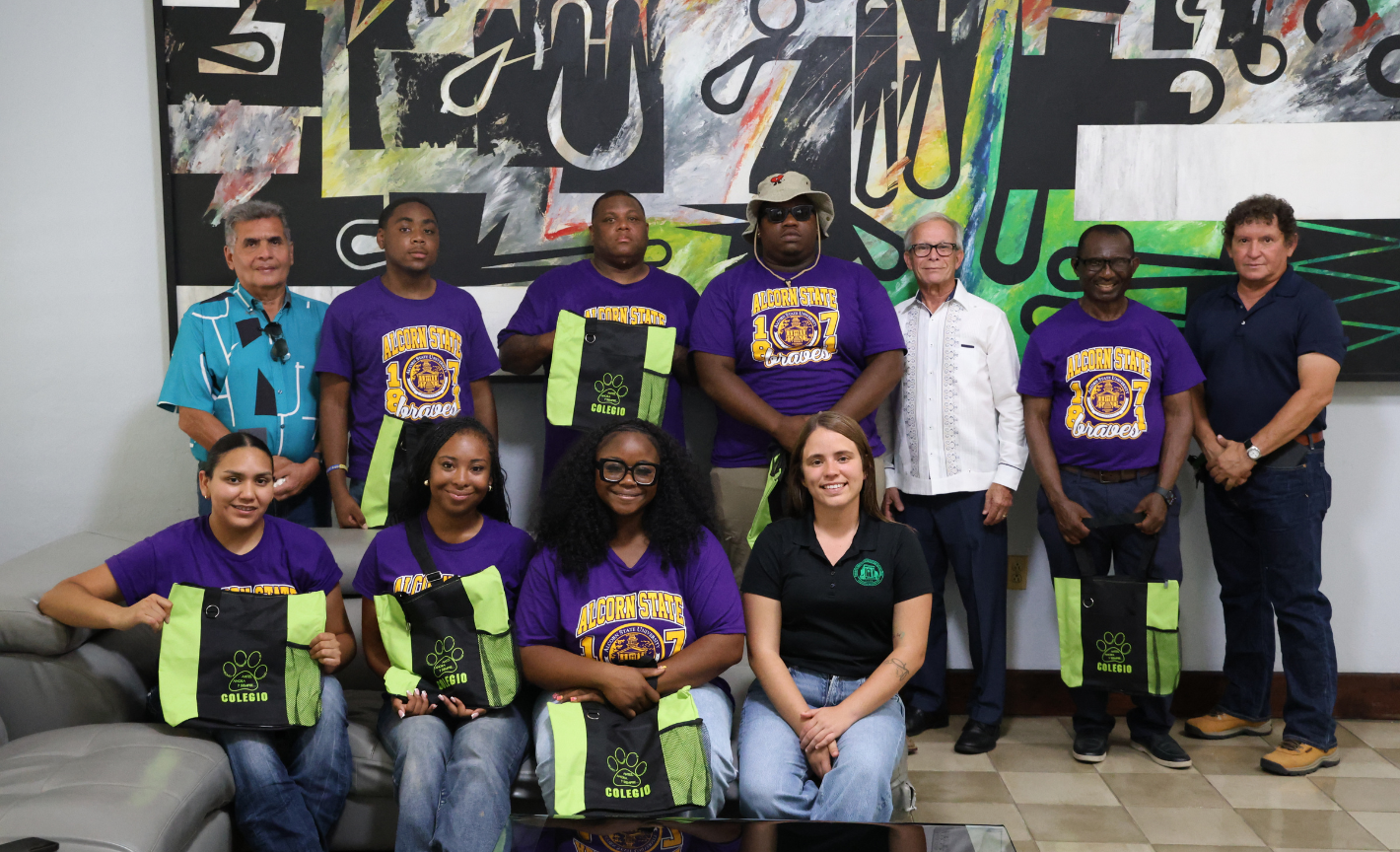
Five Alcorn State University students recently spent two weeks in Puerto Rico studying farming systems that pushed them to think beyond the traditional farm.
The trip, a collaboration between Alcorn’s College of Agriculture and Applied Sciences and the University of Puerto Rico Mayagüez, exposed them to sustainable farming, value-added production, aquaculture, biodiversity research and even artificial intelligence. Throughout, one question ran underneath the work: how could any of it strengthen agriculture back in Mississippi?
Dr. Victor Njiti, chair of the Department of Agriculture, led the group. Dr. Vickey Williams, a communications specialist, documented the trip, and Antoine Tenner handled logistics.
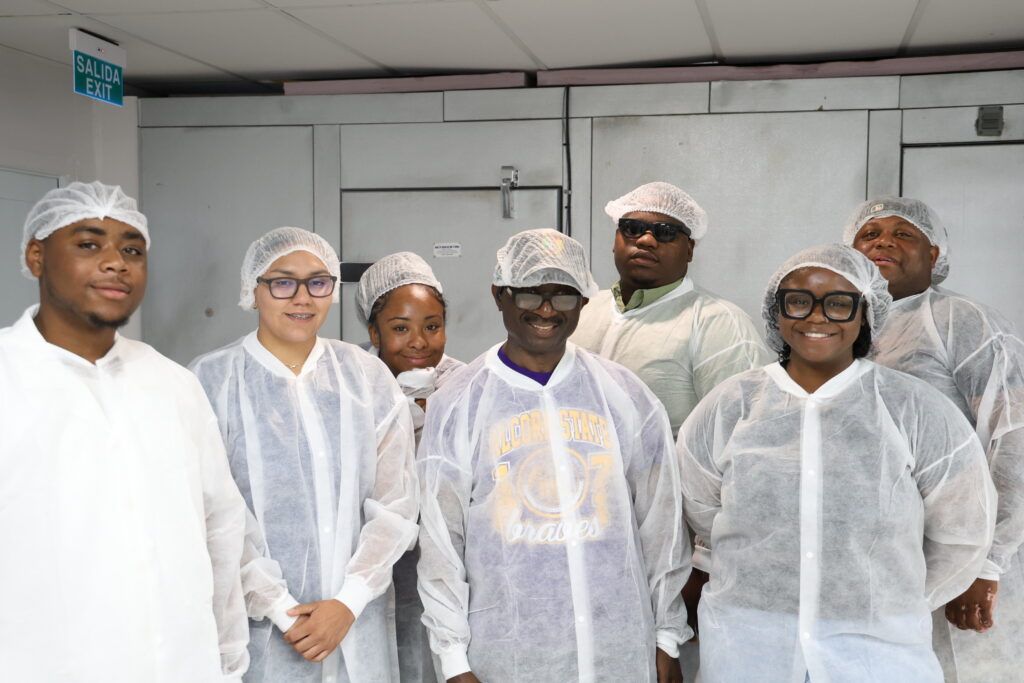
Students tour the processing facility at Tai Hay Farm. Front row (left to right): Danny Curry Jr., Lucero Esquivel, Dr. Victor Njiti and Abidemi Ayegbaroju. Back row (left to right): Alicia Solorzano, Tyrone Evans Jr. and Antoine Tenner.
At Mayagüez, the students were hosted by Abner A. Rodríguez-Carías, who chairs the animal science department, and Felix R. Román-Velázquez, a professor of analytical and environmental chemistry. Alexandra M. Virella-Quiñones, an animal science graduate student, coordinated the visit and helped strengthen ties between the two universities.
“Agriculture is a global profession, and one of the greatest gifts we can give our students is perspective,” Njiti said. “Experiential learning challenges them to step outside their comfort zones, see agriculture through a different lens and discover innovative solutions to real-world challenges.”
At El Yunque National Forest, the only tropical rainforest in the U.S. National Forest System, students traced the links between forests, water and farming, and saw how healthy ecosystems underpin sustainable agriculture.
Abidemi Ayegbaroju, an animal science graduate student from Greenwood, Mississippi, called it a turning point.
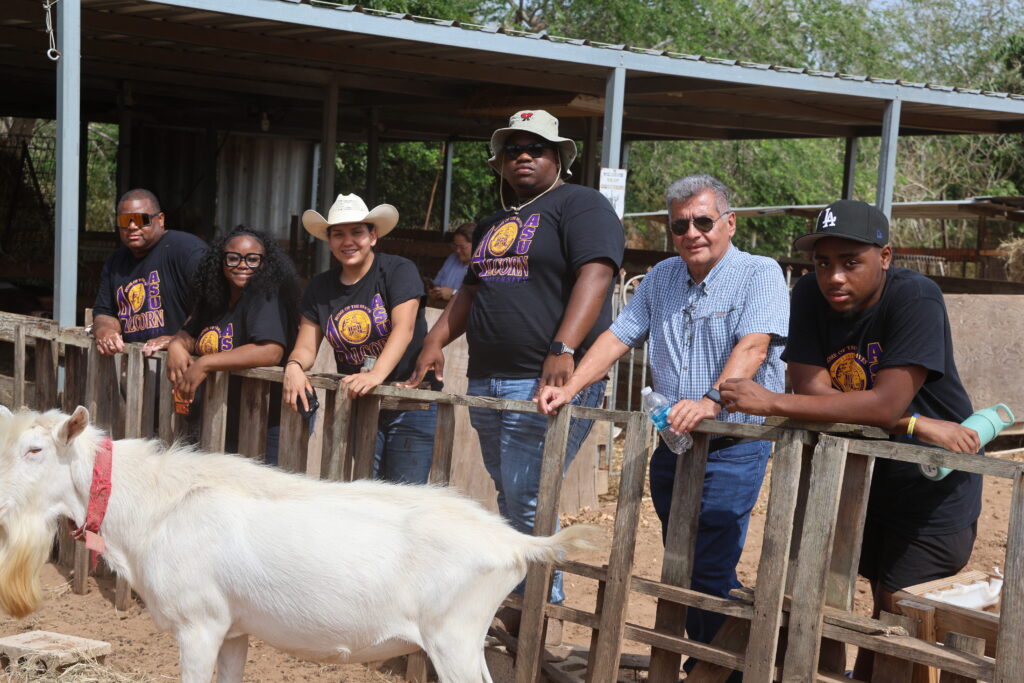
Students visited Mi Linda Cabrita to explore goat production and value-added goat milk production in Puerto Rico. Pictured from left are Antoine Tenner, Abidemi Ayegbaroju, Lucero Esquivel, Tyrone Evans Jr., Dr. Félix R. Román-Velázquez and Danny Curry Jr.
“El Yunque holds powerful and historic facts that explain why Puerto Rico is what it is today,” Ayegbaroju said. “My participation expanded my knowledge of Puerto Rico’s agroforestry and agriculture industry. Puerto Rico uses every valuable resource and values not wasting anything, which I stand behind 100 percent.”
At the Museum of Entomology and Tropical Biodiversity, the group examined how insects, biodiversity and research sustain healthy ecosystems and food production. At Frutos del Guacabo, they toured hydroponic systems and watched producers turn raw commodities into marketable goods — and saw how agritourism and consumer education add value and bolster rural economies.
Visits to Mi Linda Cabrita and Hacienda Dos Aromas showcased dairy goats, free-range poultry and diversified farming that wrings efficiency from limited acreage.
Tyrone Evans Jr., an animal science graduate student from Hermanville, Mississippi, said the visits changed how he sees production.
“I was amazed by how much they were able to produce using such a small amount of land,” Evans said. “I see us using some of the tips and techniques we learned there and bringing those ideas back home.”
For Danny Curry Jr., a plant and soil science senior from Vicksburg, Mississippi, the lesson ran deeper than technique.
“Back on the mainland, a lot of people see agriculture as another job or another way to make money, but in Puerto Rico it felt different,” Curry said. “Everything about the farms felt more important. It wasn’t just a job. It was a lifestyle.”
Across the island, the students came to see agriculture as far more than crops and livestock. Animal science, plant science, engineering, economics, conservation and public policy all converged. For many, it was the first time they viewed the field from outside their own major — animal science students weighing marketing and food systems, plant and soil science students studying livestock and sustainability.
By the end, one idea had taken hold: agriculture is defined not by a single discipline or production system, but by the people, innovation and partnerships that connect them.
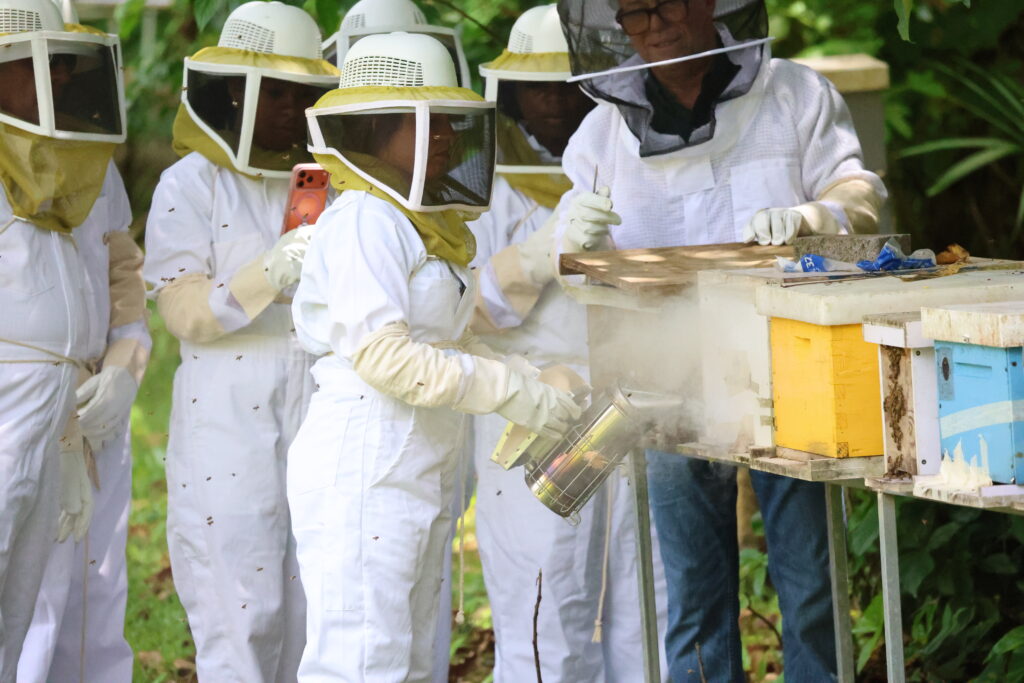
Students suited up for a hands-on beekeeping demonstration at an apiary, where they learned about Puerto Rico’s gentle Africanized honey bees and their role in tropical agriculture.
At Hacienda Buena Vista, a restored 19th-century coffee plantation still powered by water, students saw how resourcefulness has long driven agricultural success. Again and again, they watched producers adapt, to limited land, shifting markets and the lingering toll of hurricanes and COVID-19, through innovation and resilience.
At Finca Alzamora, Mayagüez’s teaching and research farm, they saw research, teaching and Extension support producers and communities, the same land-grant mission both universities share. Beyond the farms, they took in Puerto Rico’s history, culture and food, deepening their appreciation for the people and traditions behind the island’s agriculture.
Alicia Solorzano, an animal science senior from Rolling Fork, Mississippi, with a concentration in pre-veterinary medicine, said the trip sharpened her sense of how the pieces fit.
“Seeing firsthand how agriculture, conservation and culture are deeply connected strengthened my passion for veterinary medicine and reminded me of the importance of understanding agriculture from a global perspective,” Solorzano said.
Lucero Esquivel, an animal science senior from El Paso, Texas, with a concentration in pre-veterinary medicine, said talking with farmers and researchers brought her coursework to life.
“Learning from their experiences helped me connect what I have learned in class to real-life agriculture,” Esquivel said. “Seeing producers adapt and innovate made me even more excited about my future career as a veterinarian.”
For a final assignment, each student built and delivered a presentation linking their lessons in Puerto Rico to agriculture in Mississippi, identifying tropical systems, sustainable practices and technologies that could shape research, teaching and Extension at Alcorn and across the state.
“When they return home, they don’t just bring back memories,” Njiti said. “They bring back new ideas, greater confidence and a broader understanding of how they can make a lasting impact on agriculture in Mississippi and beyond.”
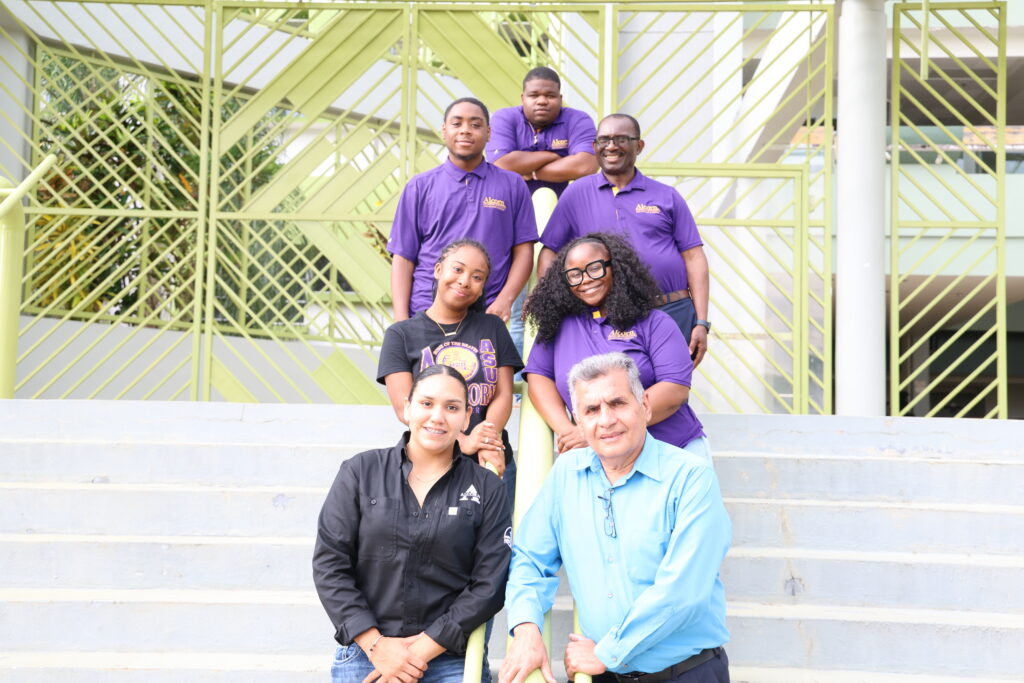
Students gathered on the steps of the Chemistry Department at the University of Puerto Rico Mayagüez following the presentation of their experiential learning projects during the program’s closing ceremony. Pictured from top to bottom are Tyrone Evans Jr.; Danny Curry Jr. (left) and Dr. Victor Njiti (right); Alicia Solorzano (left) and Abidemi Ayegbaroju (right); and Lucero Esquivel (left) and Dr. Félix R. Román-Velázquez (right).